
By Xintian Tina Wang
The award-winning study demonstrates a privacy-preserving, real-time edge computing system that uses street cameras and on-device intelligence to warn pedestrians of danger seconds before potential collisions.
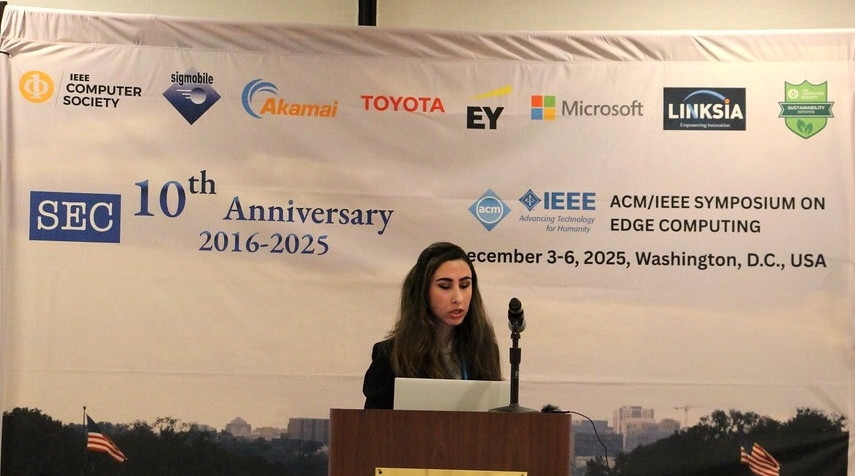
A paper led by Mahshid Ghasemi, a Ph.D. student in Columbia Electrical Engineering Department, advised by Kenneth Brayer Professor and Chair of the department Gil Zussman and Associate Professor Javad Ghaderi, has received the Best Paper Award at the 2025 ACM/IEEE Symposium on Edge Computing (SEC), held this month in Arlington, Virginia.
The award recognized the paper, “Real-time video analytics for urban safety: deployment over edge and end devices,” which presents a scalable system that uses edge computing and on-device intelligence to improve pedestrian safety while preserving privacy. The work was co-authored by researchers from Columbia Engineering, Tel Aviv University, and industry partner Kentyou.
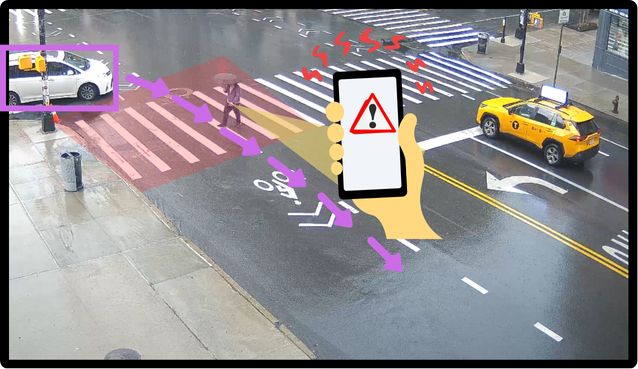
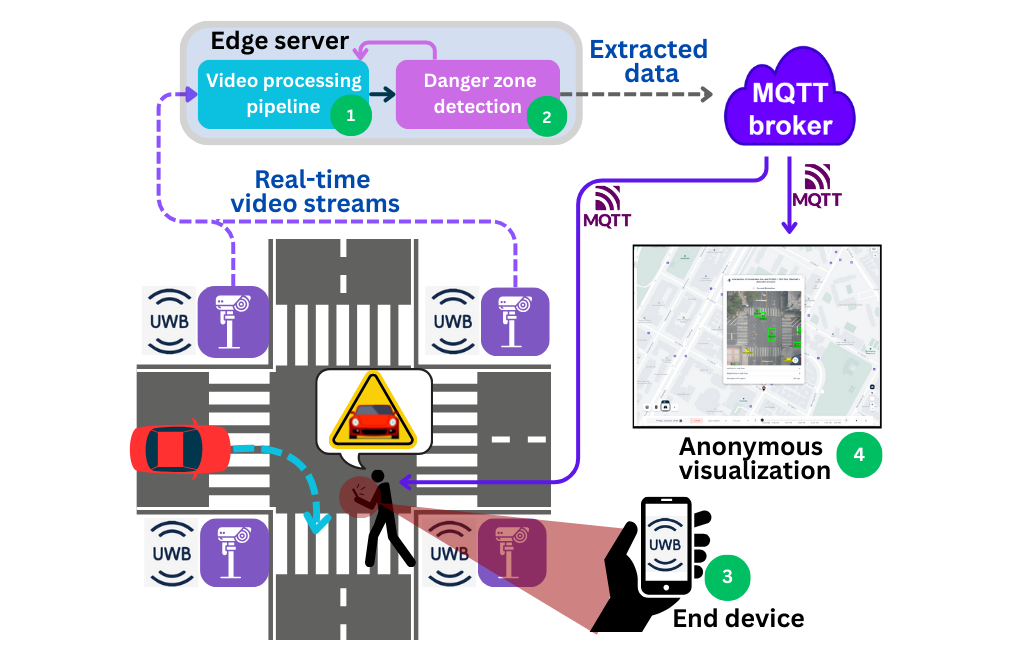
The research introduces PAVE (Pedestrian Awareness Via Edge analytics), a real-time video analytics platform that processes live feeds from street cameras on edge servers to detect pedestrians and vehicles, predict vehicle trajectories and identify potential danger zones near intersections. Instead of transmitting personal data, the system sends anonymized danger-zone information to pedestrians’ mobile devices, where alerts are generated locally, protecting user privacy. Field deployments showed the system can warn at-risk pedestrians nearly a second before a vehicle reaches them.
The project reflects a broad, cross-disciplinary collaboration. Columbia Electrical Engineering’s Professor of Professional Practice Zoran Kostic and Columbia’s Civil Engineering department’s Associate Professor Xuan Sharon Di are actively involved in the research. The system was deployed and evaluated using the National Science Foundation (NSF)–supported COSMOS testbed in New York City. The research was also supported by the NSF Center for Smart Streetscapes (CS3) Engineering Research Center (ERC), the NSF Hybrid Twin Project, and an NSF RINGS project. Computing resources were provided by EmpireAI and Nvidia grants.
SEC is a leading international conference jointly sponsored by the Association for Computing Machinery (ACM) and the Institute of Electrical and Electronics Engineers (IEEE), bringing together researchers and practitioners working at the intersection of edge computing, networking and real-time systems. The Best Paper Award is presented to work judged to make an outstanding technical and practical contribution to the field.
For Mahshid and the team, the recognition highlights the growing impact of edge computing in real-world urban environments. By combining advanced video analytics with privacy-preserving system design, the research points to new ways cities can use existing infrastructure to improve safety without compromising public trust.